

Megan Muir.jpgCONTRIBUTED BY
Megan Muir

Venture capitalist Fred Wilson recently published a guest post on his blog from Giant Robot Dinosaur about “Minimal Viable Personality”, what Fred refers to as “voice“.  Giant Robot Dinosaur, a/k/a “The Grimster”, explains why personality is a critical aspect of a successful product.  This is true for products of venture-backed companies or those funded in other ways.  I am including it here because I think it is particularly important for startups – as they usually get just one chance to succeed with an initial product – and because I love the drawing of bread versus bacon.

As The Grimster explains in his typical succinct BUT ALL CAPS manner:

  • MOST IMPORTANT STEP FOR BUILD PRODUCT IS BUILD PRODUCT.
  • SECOND MOST IMPORTANT IS BUILD PERSONALITY FOR PRODUCT.
  • NO HAVE PERSONALITY? PRODUCT BORING, NO ONE WANT.

As illustrated by this simple yet solid pictorial advice:
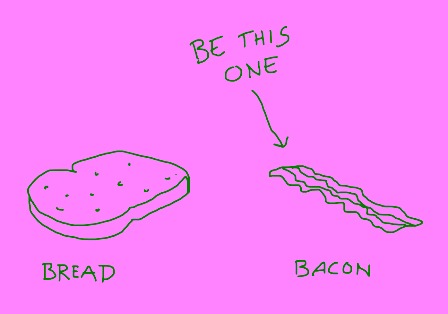
Bacon not Toast.bmp

Continue Reading Products Need Personality: BE BACON NOT BREAD

Megan Muir.jpgCONTRIBUTED BY
Megan Muir

Canadian futurist Richard Worzel recently posted a piece entitled 9 Trends in Innovation on his blog, FutureSearch. His “trends” list is made up of approaches he believes will lead to innovation and success. From his list, I’ve pulled some sections that struck me as particularly applicable to a tech startup with the goal of significant long-term growth. Read the entire piece here.

Exclusivity is overrated; fanaticism is more valuable

Worzel acknowledges that “creating fanatics is not easy. It takes years of work, meticulous attention to detail, and outstanding customer service.”  Fanatical customers are not only frequent purchasers of your products, but they can be evangelists out in the business or consumer world for your technology and influence others to give your products a try.Continue Reading A Futurist’s Take on Innovation

Megan Muir.jpgCONTRIBUTED BY
Megan Muir

Good news for budding entrepreneurs located in (or willing to relocate to) Seattle, Boston, Boulder and New York.  As reported on Geekwire and TechCrunch, TechStars has raised an additional $24M to enable the startup incubator/boot-camp to offer the companies in its summer-long program $100,000 in convertible debt.  This additional funding should enable the TechStars entrepreneurs to focus on building their early-stage companies a little longer before launching into the time-consuming fundraising process.  The new funding comes from Foundry Group, IA Ventures, Avalon Ventures
Continue Reading TechStars raises $24M – Startups Eligible for Additional Funding

Penny Herscher.jpgMegan Muir.jpgCONTRIBUTED BY
Megan Muir

Penny Herscher, President and CEO of FirstRain, a search-driven business and analytics research firm, has a recent blog post that summarizes a talk she gave to women leaders of a hardcore semiconductor company in the Valley.  She’s talking from what she knows – she started out as an R&D engineer at TI – and has held leadership positions in tech companies for nearly 20 years.

Her 5 keys to leadership as a woman in tech (although her ideas are not exclusive to women or tech) are excerpted below.  Read the full piece and other entries on her blog The Grassy Road.

1. Embrace making decisions

“Companies need people who are decisive and courageous.  A common issue with new entrepreneurs and young managers is that they hesitate to make decisions.  It’s tough when you don’t know what to do, but it’s better to make a decision quickly and decisively, and be ready to change it if you are wrong, than to hesitate, hash it over many times, or wait for someone else (your board, your team, your boss) – or even worse time and delay – to make it for you.”

Trust yourself and your judgment, and surround yourself with strong, smart people you trust who will challenge you when you are wrong.Continue Reading Penny Herscher – Thoughts on Leadership for Women in Tech

Foundry Group.jpgMegan Muir.jpgCONTRIBUTED BY
Megan Muir

If I was not already a huge fan of Foundry Group, this video (posted on Geekwire last week – thank you John Cook!) would have put me over the edge. They had me the second I saw the suits.

Last week Foundry Group released “I’m a VC”, with more than a nod to Saturday Night Live’s Digital ShortsJason Mendelson wrote, directed and sang, together with his fellow Foundry partners, Brad Feld, Seth Levine, and Ryan McIntyre,
Continue Reading Rapping VCs

In order to protect your startup’s confidential information and intellectual property, it is generally advisable to have all employees execute an employee nondisclosure and intellectual property rights assignment agreement before commencement of their service.  When these agreements contain post-employment non-solicitation and non-competition provisions, potential employees (and their counsel) often question whether or not such non-solicitation and non-competition provisions are enforceable.  For non-solicitation provisions, the answer is that they are generally enforceable if limited to the customers, prospects and employees of the company at the time such employee terminated his or her service with the company. Unfortunately, however, the answer is not as clear with respect to non-competes.  Below is a brief overview of factors to consider when evaluating the enforceability of non-competition provisions, as well as specific details regarding the enforceability of non-competes in Washington and other states.
Continue Reading Are non-competition and non-solicitation provisions enforceable?

Here is a helpful reminder for startups as a cost-effective way to deal with potential mischief on the Internet.  As the article explains, the “dot-xxx” (.XXX) top-level domain is just days from its launch as the new home for adult content on the Internet.  As part of the launch, companies that do not want their brands associated with adult content have an opportunity to block their registered trademarks from being registered as .XXX domains.  Read more here.Continue Reading Deadline to Block Trademarks from New Adult Dot.XXX Top-Level Domain

pic-tyler.jpgCONTRIBUTED BY
Tyler Hollenbeck
tyler.hollenbeck@dlapiper.com

In an earlier post we defined the term “pre-money valuation” and explained how this valuation is used to calculate the price per share at which stock is sold in a VC financing.  Actually determining this “pre-money” or “pre-investment” valuation, though, is often one of the most fundamental terms for founders and investors to negotiate, as it effectively sets the relative percentage ownership levels of the two groups (assuming a fixed investment amount).

Despite this fundamental character, “calculating” an appropriate valuation (or even a range

Continue Reading Understanding VC Financings – Valuation

Courtesy of Itai Nevo, a partner in DLA Piper’s Boston office, below is an informal survey of current trends regarding single vs. double trigger stock option acceleration from DLA Piper’s Atlanta, Boston, Chicago, DC, Northern and Southern California, Reston, Seattle and Texas offices.

(1)  The common denominator (with some exceptions described below) was a double trigger approach – typically 12 months, sometimes 18 months, following a sale event. This was the most common approach (as opposed to single trigger) both geographically (East vs. West Coast) and across stages of company maturity (i.e., seed  stage through VC-backed).

(2)  For the most part (see item 3 below), acceleration terms were offered only to senior management and on an agreement-basis rather than at the option plan level. When offered, full acceleration was the most common approach with a recent slight trend toward 50-75% acceleration of unvested shares at the time of termination.

(3)  Rank and file acceleration was not overly common. Some Northern California- and Boston-based partners reported seeing an emerging trend in affording vesting acceleration (generally double trigger) for rank and file employees. If acceleration is in fact offered, rank and file participants often got six to12 months or some partial percentage.Continue Reading Trends re Stock Option Acceleration: Single vs. Double Trigger